
Discover what a Bill of Materials is and why it's vital for manufacturing. Learn about key components, BOM types, and best practices for product creation.
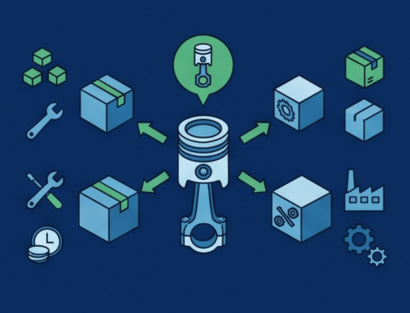
Have you ever wondered how companies keep track of every screw, wire, and circuit board that goes into creating a smartphone, a car, or even a simple kitchen appliance? The answer lies in something called a Bill of Materials (BOM). Without this critical product development document, chaos would reign in any manufacturing process!
In this blog post, we’ll break down what a BOM is, why a well-managed BOM matters for businesses involved in product creation and inventory management, its key components, and how different types of BOMs serve different needs in manufacturing.
We’ll also explore best practices for creating and managing BOMs so you can keep your production process streamlined, cost-effective, and free of unpleasant surprises.
A bill of materials is a comprehensive list of the raw materials, components, assemblies, subassemblies, and parts, as well as the quantities of each needed for each production batch, that help in manufacturing a product. It provides a structured outline of everything needed to ensure that everyone involved in the production process, from engineers to procurement specialists, is on the same page.
A BOM isn’t just a static list; it’s a living document that plays a crucial role throughout the entire product development lifecycle, from the first sketch on a whiteboard to the final product roll-off. Below are the key ways a BOM influences various stages of product development:
A BOM guarantees that every single item needed for production is accounted for. This degree of accuracy cuts down on manufacturing errors, such as running out of a critical component mid-assembly or discovering too late that a specific part number was misquoted.
When a BOM is accurate, the risk of production line stops, rework, or last-minute part substitutions decreases, which saves both time and money.
During the design phase, engineers heavily rely on BOMs to constantly tweak product specifications—sometimes adding new materials or replacing existing ones. A BOM, which can also be represented visually as a product structure tree, must reflect these changes to ensure that any subsequent department involved is working off the latest specifications.
This close link between design changes and BOM updates means that engineers have a clear record of what has been tested, approved, or phased out. A BOM also promotes collaboration across different teams, whether mechanical, electrical, or software engineering, for more complex products.
Every part listed in a BOM has a cost, be it the raw material cost, shipping cost, or handling fees. By summing up all these costs, manufacturers can get a quick snapshot of unit cost for the entire product.
By knowing the cost of each component and the quantity needed, businesses can calculate the total cost of manufacturing a product and determine the profitability margin. If the estimated cost overshoots the target, the design can be revisited to look for more cost-effective alternatives.
A BOM is also invaluable for procurement teams. By knowing exactly which parts are required, how many units are needed, and when they’re needed, suppliers and contract manufacturers can be identified and orders placed well in advance. This helps avoid emergency sourcing, which can be more expensive.
Having a well-organized BOM helps in creating relationships with preferred suppliers, bulk purchasing, and even negotiating better pricing terms.
While BOMs may vary slightly from company to company, certain data fields tend to be universal. Let’s look at all the components that make up this crucial document.
The part number is the unique identifier for each item or component. It differentiates parts that might otherwise have very similar names or functions. A well-structured part numbering system saves you from mix-ups and speeds up communication between departments.
The part name is a short descriptive label, like “Hex Bolt” or “Processor Chip,” that makes it easier for those unfamiliar with the part numbering system to understand what a part actually is. While the part number is more precise, the part name is more user-friendly for quick reference.
The quantity tells you exactly how many units of a particular part are needed for each product being built. Whether it’s one CPU per circuit board or ten bolts per chassis, specifying quantity is crucial for efficient inventory and cost control.
The unit of measure (UoM) could be “pieces,” “kilograms,” “liters,” or any other unit that accurately describes how the part is managed. Using the correct UoM ensures clarity and prevents confusion—especially for bulk items that are purchased in large volumes but used in smaller increments.
Is the item purchased from an external supplier, or is it manufactured in-house? The procurement type field clarifies the source of each component, helping procurement managers know where to source parts and engineering teams to determine lead times.
Commonly used in electronic BOMs, reference designators are labels (like R1, C2, U3) that pinpoint where a component fits on a circuit board or subassembly. They help ensure parts are placed in their correct locations, thus preventing errors in the assembly process.
Often BOMs will list cost per unit so that production planners can quickly estimate the total cost of the product. This field is especially helpful for cost reduction initiatives and for evaluating design alternatives.
Not all BOMs serve the same function. Different stages of the product lifecycle or different organizational needs may call for specific types of BOMs, each formatted and used differently.
This BOM is tailored for the production floor. It details not just the parts and raw materials required, but also the assembly instructions and any tooling or machine setups required.
The MBOM is what manufacturing supervisors use to plan workforce needs, run production schedules, and ensure each step of the assembly line is primed with the right parts at the right time.
Created by design engineers, the engineering bill of materials lays out the product from a functional standpoint. It’s often the first BOM to be developed, capturing a product’s design intent without fully detailing the manufacturing process steps.
EBOMs are critical for collaboration among designers, engineers, and researchers who need a high-level view of how different components fit together.
Sometimes a company sells products as part of a bundle or kit. The sales BOM reflects how items are packaged or sold as a single unit, even though they might be stocked or manufactured separately.
This is common in retail or e-commerce, where a “family bundle” might include multiple components sold under one SKU. Sales BOMs help sales teams quote and process orders more accurately.
A service BOM is particularly important for products that require ongoing maintenance or have replacement parts. It outlines which parts or subassemblies may need to be replaced over the product’s lifetime. This modular BOM structure is vital for service technicians and also for customers who need to order spare parts.
A configurable BOM (cBOM) includes all components needed to design and manufacture products tailored to customer specifications. cBOMs are particularly valuable in industries with highly customizable offerings, such as job shops, heavy machinery, and industrial equipment.
Once a product design is finalized and ready for production, BOMs stand at the core of various manufacturing functions. Let’s look at how BOMs integrate into the broader production cycle:
Production planning hinges on having the right parts available in the right quantities at the right time. Effective BOM management sets the foundation for creating production schedules, estimating labor hours, and ensuring that each stage of production is properly resourced.
If your BOM is up-to-date, production managers can better anticipate bottlenecks and allocate manpower efficiently.
Inventory management systems rely on BOM data to track how many units of each component are required as well as how many finished goods can be produced from the current inventory. Through this integration, it becomes easier to minimize stockouts (which cause production delays) and overstocking (which ties up capital unnecessarily).
Keeping a smooth supply chain is easier when suppliers know exactly what you need and when you need it. By sharing relevant BOM information with suppliers, you can negotiate long-term contracts, bulk discounts, and better shipment schedules. This transparency fosters trust and can lead to cost savings and shorter lead times.
When issues arise—like a defective batch of screws or a faulty circuit board—quality control teams can trace problems back to a specific part number, lot number, or supplier.
The BOM provides a clear roadmap for root cause analysis and corrective actions. This level of detail also ensures that quality checks are conducted on all critical components before they enter production.
In manufacturing, profitability is often a function of controlling costs. By keeping an eye on the Cost Per Unit from the BOM, financial analysts can quickly see when expenses start to climb and take steps to renegotiate supplier contracts or find alternative materials.
BOMs are a critical resource for cost control and budget management throughout the manufacturing lifecycle.
A well-structured BOM doesn’t mean simply entering data—it takes careful planning, attention to detail, and regular upkeep. Here is a step-by-step approach to creating and managing a BOM that can make life easier for your team:
In any manufacturing environment, a well-structured, accurate BOM holds great value. It makes product development, cost control, procurement strategy, and inventory management easier to manage and even facilitates adaptation to design changes, supplier updates, and shifts in market demand, ensuring you have the clarity and control to stay competitive.
Investing time in setting up the right BOM structure today will pay off in smoother operations, fewer errors, and quicker turnaround times tomorrow. And if you’re looking for a tool that makes all of this super simple, consider using an ERP system like KIMCO.
KIMCO ERP offers a modern solution that integrates BOM data with inventory, purchasing, and production workflows to give you a real-time snapshot of your manufacturing process. It automates tasks like cost roll-up, stock level updates, and purchase order creation to ensure you always have the most accurate information at your fingertips.
Schedule a free walkthrough of our tool today to learn how you can simplify your product lifecycle management.

Start your journey with KIMCO today and explore how our manufacturing management software can simplify your operations, step up productivity, and help you meet all your business goals.
